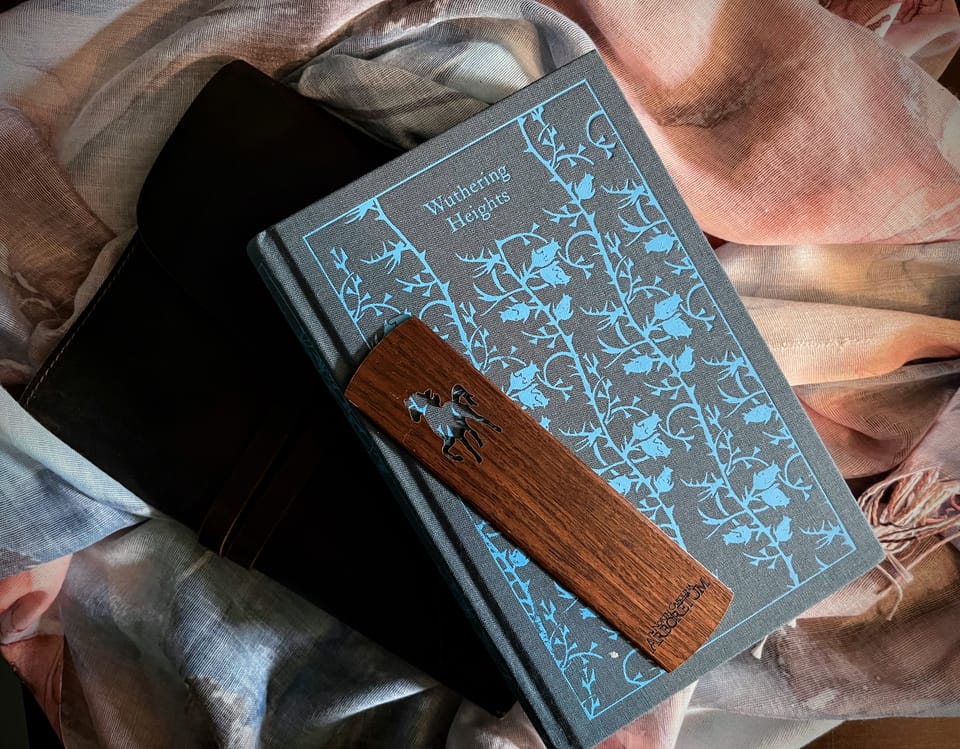
Wuthering Heights was a whirlwind to read. When I first tried picking up the novel, I floundered in the first few chapters, struggling to understand the basic concepts of the story. I set it aside for a while until I could sit down and give it my full attention. When I came back to the novel, I had the capacity to slow down and turn off the speed-reader in me. I broke it down, chapter by chapter.
The book is quite large and written in such a way that is hard to understand, especially if the reader is coming out of a fast-paced action book. It’s not a book to read for pleasure, if by pleasure you mean thrilling battles and witty sarcasm. However, it has its own merits if the reader is flexible enough to come at it from a different perspective.
At first glance, some might proclaim Wuthering Heights to be a romance, a tragic romance between Heathcliff and Catherine Earnshaw. But the true nature of this story is a tale of humanity, and the lack thereof. At the beginning of the novel, the narrator Lockwood introduces the reader to three pivotal characters: Heathcliff, Catherine Linton, and Hareton Earnshaw. He immediately sees the contempt and tension between the three.
Lockwood perceives himself to be some kind of hero to the story, endeavoring to discover the story behind the abuse, deceit, and vice in the household. But as the story evolves, he comes to realize that there is no hero. The narrative is told to him by an old servant, someone not untainted by the lies and hate revolving around Wuthering Heights. But even in her twisted tale shines one nugget of truth: hate is a broken thing. And once it has a hold, it doesn’t let go.
The spite that drips from this story traps the characters in their own web. They spin lies, throw punches with their words. And each syllable that leaves their lips adds to the chains that hold them there. Catherine Earnshaw, a central character around whom the tale orbits, is stuck in the hate and the lies. But she herself has lived in it so long that she has adopted it, weaponized it. Her sharp tongue cuts those around her, isolating her from the very thing she’s desperate for.
The whole book is marinated in this vice. And for that, it is hard to enjoy. It’s dark and gothic, and in some ways it is understandable why it was disliked in its time.
But Wuthering Heights is not just ‘some’ novel. It isn’t a pleasurable read. It is a tragedy. The overabundance of misery and hate becomes almost satirical, like a mockery of humanity itself, until the reader realizes just how real it can be. It mirrors all too well the behavior of humankind, enlarging the brokenness to a degree that no one can ignore. It is a masterpiece that is hard to face, hard to read. Because when you boil it down, we could each be in that story, relying on our own vice to pull ourselves out of the pit. Hate breeds hate. Anger births resentment. By grace only can we climb out of the cesspit.
I don’t recommend this book as a book to just pick off the shelf, because in all likelihood it would be put back down again just as quickly. It’s a harsh novel and one that I’ll have to reread again someday. I don’t believe that I have picked up all of the nuance the story carries. But it was worth the time and effort to reach the end.
Trigger Warnings: Violence, Forced Marriage, Emotional/Physical/Child Abuse & Neglect, Racism, Disturbing a Grave, Self-Starvation, Animal Cruelty, Alcoholism, Kidnapping/Confinement.
Subscribe to my newsletter.
Become a subscriber receive the latest updates in your inbox.